Let’s be honest: writing cover letters is often the most dreaded part of the job hunt. You stare at a blank screen, wondering if anyone is actually going to read what you write, or if you should just copy-paste that same template you used three years ago.
Here’s the truth: while some recruiters skip them, a **compelling** cover letter is often the tie-breaker. When two candidates have similar experience, the one who can articulate *why* they want this specific job—and *how* they can help the team immediately—is the one who gets the call.
The 'Why' Before the 'How'
Most people treat a cover letter as a resume summary. They write: "I am writing to apply for X. I have 5 years of experience in Y. I am hard-working."
That’s boring. And it doesn't tell the hiring manager anything they couldn't find in your bullet points.
Instead, think of your cover letter as **selling a solution**. A company posts a job because they have a problem—they need more sales, better code, cleaner data, or happier customers. Your letter shouldn't just say "I'm good." It should say, "I understand your problem, and here is how I’ve solved it before."
Step 1: Identify the Company's 'Pain'
Before typing a single word, do five minutes of detective work. Read the job description and ask yourself:
- What is the biggest challenge this role needs to solve?
- Is the company growing fast? (They need speed and adaptability.)
- Are they an established corporation? (They might value stability and process optimization.)
- What values do they mention repeatedly on their 'About Us' page?
If you can figure out what keeps the hiring manager up at night, you can write a letter that helps them sleep better.
Step 2: The 3-Paragraph Formula
You don't need a novel. You need three solid paragraphs.
1. The Hook (The Opening)
Ditch "To Whom It May Concern" and "I am applying for..." if you can. Start with enthusiasm or a specific connection to the brand.
“As a long-time user of [Product], I’ve always admired how you handle [Feature]. When I saw you were looking for a Product Manager to expand that specific vertical, I knew I had to apply.”
2. The Bridge (The Evidence)
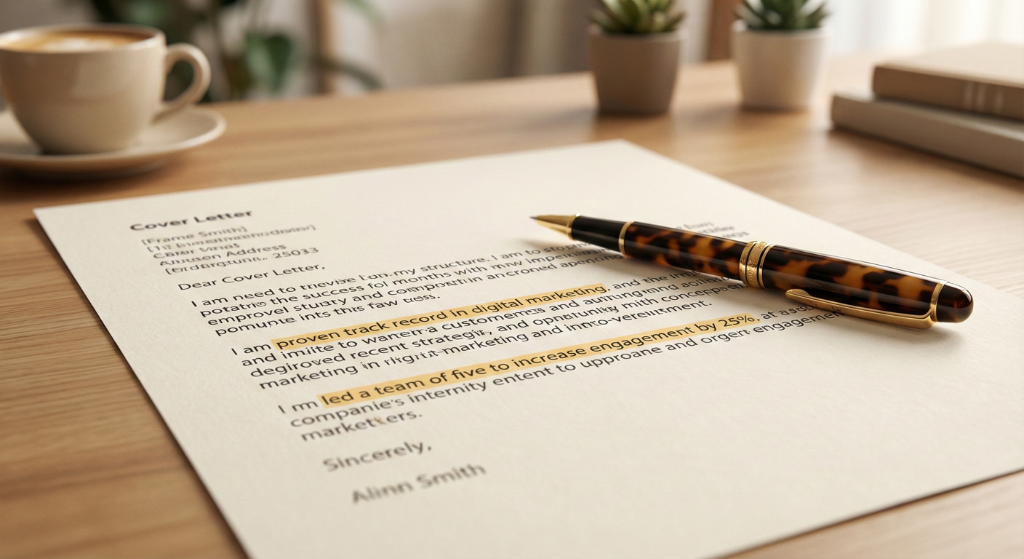
This is where you connect the dots. Pick **one or two** major achievements from your past that directly relate to the job you want. Don't list everything. Go deep on the most relevant win.
“In your job description, you mentioned needing to reduce customer churn. In my last role at [Company], I led a project that identified at-risk users and implemented a new onboarding flow, which reduced churn by 15% in six months. I’d love to bring that same data-driven approach to your team.”
3. The Closer (The Call to Action)
Be confident, brief, and polite. Reiterate your excitement and invite the next step.
“I’d be thrilled to discuss how my experience in [Skill] can help [Company] achieve [Goal]. Thank you for your time and consideration.”
Tone Check: Professional but Human
A common mistake is sounding like a robot. You want to sound professional, yes, but you also want to sound like a person someone would enjoy working with for 40 hours a week.
- **Bad:** "Utilization of my extensive skill set will result in optimal outcomes."
- **Good:** "I love using my skills to solve complex problems and get real results."
Read your letter out loud. If you stumble over a sentence or it sounds like something a Victorian lawyer would say, rewrite it.
Avoid These Traps
- **Generic Greetings:** Try to find the hiring manager's name on LinkedIn. If you can't, "Dear Hiring Manager" or "Dear [Team Name] Team" is better than "To Whom It May Concern."
- **Typos:** This is obvious, but deadly. A cover letter claiming you have "attention to detail" with a typo in the first sentence is an immediate rejection.
- **Focusing on Benefits to YOU:** Don't say "I want this job because it would be a great stepping stone for my career." Say "I want this job because I can help you achieve X."
Bringing It All Together
Your cover letter is your voice in the room before you actually get in the room. Make it count. Keep it under one page, keep it focused on the company's needs, and let a little bit of your genuine personality shine through. That’s how you stand out.